
The super El Niño that is on the way is on the minds of every gardener in South Africa. Doing some research on what we can do beyond the obvious to help our gardens during period of extreme heat, I came across the lovely phrase “Meet Nature halfway.”
In many ways, plants know what to do when temperatures soar. Wilting is a way to reduce water loss. Meet Nature halfway by watering in the cooler morning hours so plants have a chance to fully hydrate before the heat of the day sets in. Remember that plants don’t take in water through their leaves, so spot watering at the base is more efficient than using sprinklers and even spray nozzles. Perennials, trees and shrubs planted within the past year need special attention as most of their roots will still be in the original root ball which can dry out quickly.
When a plant looks like it is ailing during a heat wave, the answer is not to up your fertiliser regime. Plant processes slow down when temperatures rise above 30˚C, and fertilising will only increase the plant’s stress by promoting growth it can’t support. Meet Nature halfway here by feeding the soil with an organic mulch. A layer of wood chips, grass clippings, shredded leaves, straw, or compost not only keeps the soil surface cool and reduces drying out, it contributes to soil health. Healthy soil with higher organic matter content retains moisture better and acts as a natural insulator, preventing temperature fluctuations.
Many plants stop flowering during extreme heat. Again – don’t feed. Meet Nature halfway by removing spent flowers so that precious resources are not spent on fruit and seed development. This will help to set the plant up to bloom again once the heat wave passes.
IN THE GARDEN
My good friend and fellow no-holds-barred plant enthusiast Jason Sampson of Pretoria University likes to say his favourite colour is October. I couldn’t agree more.
All but the most neglected gardens are a riot of flowers at this time of year, and I for one have fallen in love with my garden again – as I do every Spring! It is extremely overgrown but with wonderful pops of colour all over.
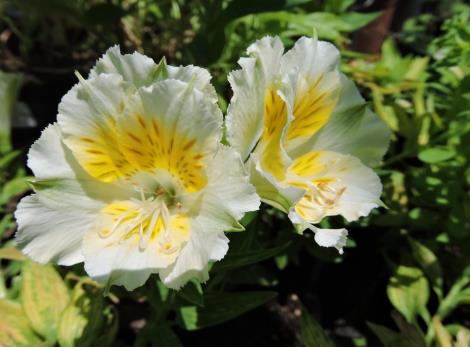
Short white Alstroemaria
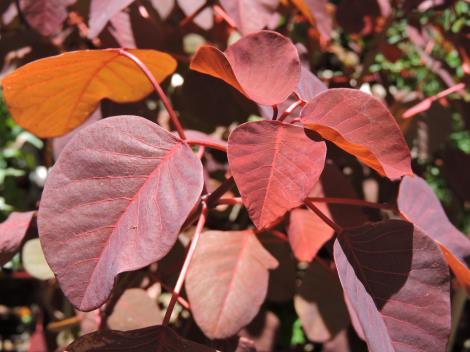
Euphorbia cotonifolia
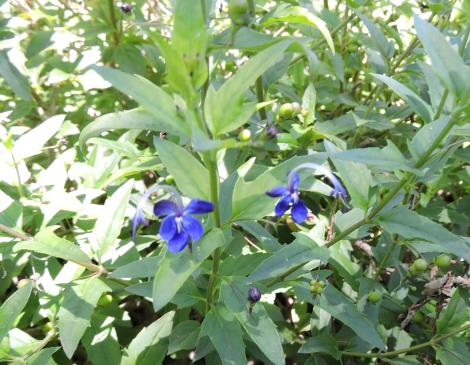
Rotheca caerulea
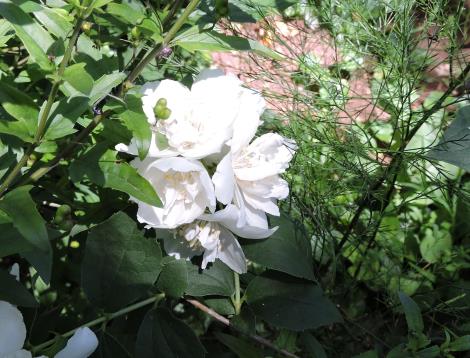
Philadelphus coronarius
We have employed a new gardener whose only task is to weed. He has done a sterling job so far, but has strict instructions NOT to touch the onion weed which takes special handling and will be attended to by the entire team next week. Years of experience have taught us to first carefully remove the flowering stalks with secateurs, and then to dig out the root ball with extra soil on each bulb.
IN THE NURSERY
Click here to view all the plants in this newsletter on one website page.
Indigenous plants
Helichrysum cymosum is a gorgeous approximately 30cm high perennial groundcover with woolly stems, small aromatic silver leaves, and clusters of yellow flowers in late summer. It does well in sun or semi-shade.
A rosette of broad tapering leaves that emerges from the top of the Merwilla plumbea bulb in spring is followed by racemes of star-shaped night-scented violet flowers. This is an interesting very hardy deciduous bulb that reaches about 75cm in height when in flower, and wants a sunny position.
Another plant that lends fragrance to the evening hours and attracts night pollinators is Pelargonium gibbosum. This semi-succulent evergreen approximately one metre tall perennial has notched blue-grey leaves and clusters of lime-yellow flowers from summer to autumn. Indigenous to the Western Cape, it wants dry sandy soil and sun to semi-shade.
The Fireball lily, Scadoxus multiflorus ssp. Katherinae, has large thin textured leaves with a prominent midrib, and huge spherical umbels of orange-red flowers from summer to autumn. This is a robust semi-hardy evergreen bulb that grows about 70 cm tall and is happy in shade or semi-shade.
Exotic plants
The compact free-flowering Brugmansia - Angels Pink Pearl gives you lovely pale pink double flowers from summer to autumn. This is a hardy evergreen shrub that grows about 2m high and likes sum to semi-shade and acid soil.
Salvia splendens - Van Houttei is a deceptively delicate-looking about 75cm tall evergreen perennial with pointed toothed pale green leaves and long tubular burgundy-red flowers all season. It looks lovely in a shady to semi-shady mixed border.
The multi-stemmed black elder (Sambucus - Black lace) has finely cut almost black foliage and panicles of fragrant white flowers in summer. This approximately 3m high deciduous shrub with medicinal properties can take sun to semi-shade, wants moist soil, and responds well to hard pruning in early spring.
Who doesn’t love a wisteria. The very hardy deciduous Wisteria sinensis (the Japanese wisteria) grows to a height of 6m, and looks good free-standing or trained on a wall or over an arch. Its pendant racemes of fragrant blue flowers are once of spring’s blessings. We have plants in 10l bags.
SNIPPETS
Wherever you live, you are sure to find open gardens in the next few weeks - Elgin, Rustenburg, Free State, Bedford, Howick… I just love it!
The Chelsea award-winning Life After Fire exhibition still runs to 8 November at Lifestyle Home Garden in Randpark Ridge, Johannesburg. Tickets are available on Webtickets.
Safari Garden Centre in Pretoria is holding its Rare & Exotic Plant Fair this weekend, 31 Oct-1 Nov.
FUN FACT
Wisteria grown from seed can take 8-10 years to flower!
Happy gardening!
Leoné
082 482 0257