
This newsletter was going to be about a lovely pale yellow anisodontea we have in the garden, but the fascinating information I stumbled upon while doing some research quickly persuaded me to broaden my focus to the mallow family of which this little shrub is a member.
With about 85 genera and 1,500 species worldwide, ‘broaden’ is the operative word here. The very user-friendly wildflowers-and-weeds website offers a neat description of what qualifies a plant as a mallow: “A funnel-shaped flower with 5 separate petals and a distinctive column of stamens surrounding the pistil. There are also 3-5 partially united sepals, often surrounded by several bracts.”
While that certainly appears to account for quite a variety of plants – hibiscus, abutilon, and hollyhock spring to mind – there are also a few who-would-have-thoughts among them. Cotton (one of the world’s leading agricultural crops) is a member of the mallow family – the only one which is not safe for human consumption as it contains a toxic compound called gossypol. All the others are edible (think marshmallows) or have medicinal uses such as to soothe inflamed skin or sore throat. Okra, it turns out, is the edible fruit of a variety of hibiscus. And my ever-knowledgeable friend Jason Sampson informed me that the mighty baobab also belongs to the mallow family in modern botanical classification!
How true it is that the more we know, the more there is to know.
IN THE GARDEN
As the plants seem to sense that the time for rest is approaching, we are very busy weeding and cutting back. Every season, it astonishes me how much stock we are able to lift from the garden as plants sell out in the nursery.
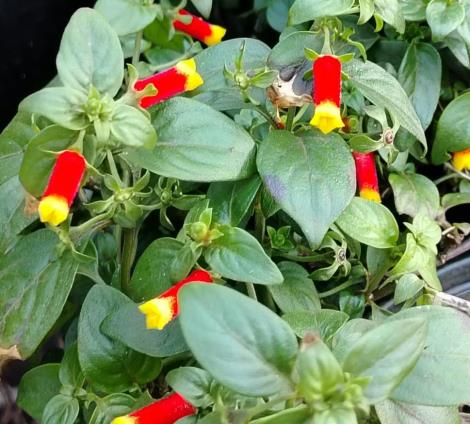
Manettia luteorubra
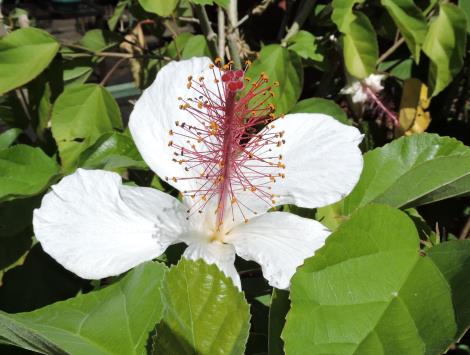
Hibiscus arnottianus
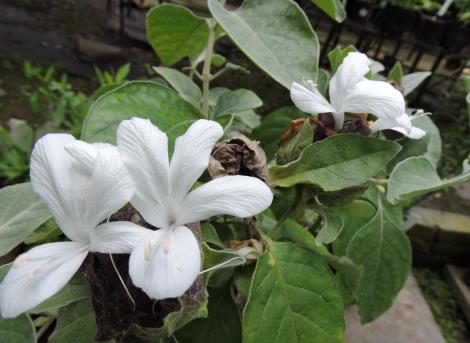
Barleria albostellata
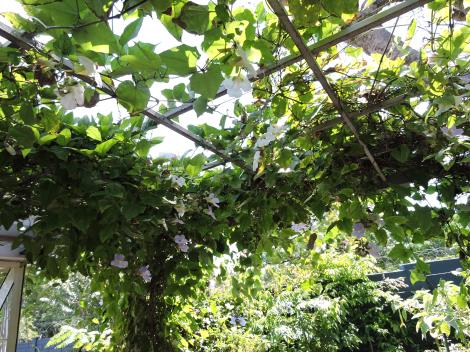
Thunbergia grandiflora starting to cover the pergola
A few newsletters back, I reported on the new strategy we were going to try to protect our patch of lawn in the front garden from the two rambunctious dogs. Pegging a layer of chicken wire down appears to have worked – perhaps helped along by the copious amount of rain we have had! We actually have some greenery now where there was previously a dusty brown patch.

Our new lawn - long may it last!
IN THE NURSERY
Click here to view all the plants in this newsletter on one website page.
Indigenous plants
Agapanthus inapertus - sky blue is a very hardy deciduous clump-forming grassland bulb with upright narrow straplike leaves and drooping umbels of sky blue flowers in summer. Indigenous to KwaZulu-Natal and Mpumalanga, it wants full sun but moist soil.
Another very hardy, deciduous, moisture-loving bulb is the Orange River lily, Crinum bulbispernum. Reaching an average height of one metre, it has grey-green arching leaves with wavy margins, and very beautiful scented pink and white flowers in spring. It is happy in sun to semi-shade.
Gnidia squarrosa, on the other hand, wants full sun and dry sandy soil. With needle-like leaves mostly at the tips of the branches, this gorgeous ‘see-through’ shrub has clusters of yellow flowers in spring. It is evergreen and hardy, and grows on average 75cm high.
Gardeners with a water feature can consider the deciduous bog plant Marsilea schelpeana for its pretty foliage. Listed as vulnerable on the Sanbi red data list, this mat-forming fresh water fern is rooted in mud and has creeping stem and floating roundish irregularly grooved leaves.
Exotic plants
The bamboo orchid arundina graminifolia is a tall robust terrestrial orchid with bamboo-like stems, veined leaves, and Cattleya type white or pink flowers in summer. It grows on average 2m high and likes semi-shade and dry sandy soil. We have plants in 18cm pots.
Echinops ritro (the small globe thistle) is another plant to consider if you have dry sandy soil. This tough approximately 60cm high deciduous perennial has spiney woolly dark green leaves, and interesting rounded steel-blue flowers in summer which attract bees and butterflies. It is happy in sun to semi-shade. A good cut flower.
The soft-stemmed evergreen shrub Strobilanthes dyerianus has thick quilted purple leaves with an iridescent silver overlay, and pale blue flower spikes in autumn. Happy in shade to semi-shade, it is not suited to cold areas, but makes a good indoor plant. You can expect it to grow up to 1.2 metres high.
The large bright orange flowers of Thunbergia gregorii really cheer up the garden all season. This woody-based evergreen perennial climber with furry heart-shaped leaves grows on average three metres high and wants full sun.
SNIPPETS
In a repeat of its National Gardens Week, SANBI is offering South African citizens and residents free access to national botanical and zoological gardens from 9 to 15 March. Take advantage of this opportunity to revisit old favourites or to explore lesser-known gardens that may be on your bucket list.
Safari Garden Centre in Lynnwood Road, Pretoria has a rare and exotic plant fair coming up on 25 March. See their Facebook page for more details.
FUN FACT
Back in the 1800s, French confectioners made marshmallows as a medicinal treat by boiling the root sap of the marshmallow plant (Althaea officinalis) with sugar or honey and egg whites, and whipping the mixture by hand into a fluffy, chewy paste that took up to two days to solidify. Modern marshmallow production is of course highly automated and uses gelatine, not plant material.
Happy gardening!
Leoné
082 482 0257