
There are some plants that have such unique or quirky features that they warrant showcasing in a newsletter. Laportea grossa (spotted nettle) is such a one.
The flowers of this plant – branched inflorescences in the axils of the leaves – are not particularly decorative. It is the glossy dark green leaves with conspicuous white spots that make it such a good choice for brightening up a shady area in the garden. It can also work as a container plant on a shady patio, but an out of the way spot is better in order minimise inadvertent encounters with the pain it can inflict!
What I find fascinating is that every part on the plant is covered in long slender stinging hairs, and each white spot on the leaves is host to one. The brittle tip of the hair breaks when touched, exposing a sharp point that penetrates the skin and injects the toxin.
If you feel ready to take Laportea grossa on as an addition to your garden, make sure it has full to light shade, well-drained and well-composted soil. And arm yourself with thick garden gloves when planting out! With good reason, this is a plant my staff hate propagating. The good news, though, is that it self-seeds.
Acknowledgements to PlantZAfrica and Alice Notten of Kirstenbosch Botanical Garden for this information.
IN THE GARDEN
After what feels like an English winter – in terms of length – we wait with bated breath for spring to arrive. I walked through the garden this morning, and apart from the flowering quince there was not even a smidgen of growth to suggest that spring is on its way. No doubt that will change over the next two weeks.
Lebo got stuck in early with pruning the plants in the garden, and we have started fertilising – because as Annie Mashishi used to say, “21 Julie is plant tyd!”

Waiting for spring

A stunted winter Justicea carnea flower
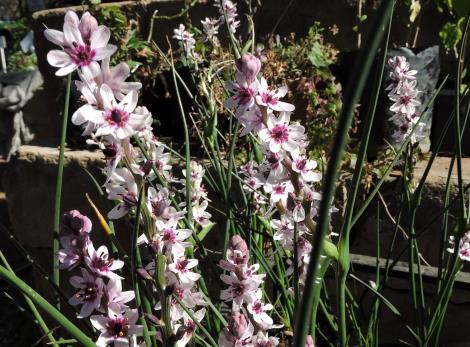
Wurmbea stricta - what a winter joy!

A solitary flower on the Fuschia arborescens
IN THE NURSERY
Click here to view all the plants in this newsletter on one website page.
Indigenous plants
We cannot approach the end of winter without featuring Aponogeton distachyos, the waterblommetjie! The edible white flowers of this hardy deciduous aquatic perennial are the distinctive ingredient in Western Cape cuisine during the cold, rainy months. It wants full sun but make sure there is at least 30cm of water above the plant.
Another pretty bog plant is Cotula coronopifolia (aka water buttons). This is a very hardy evergreen creeping aquatic perennial with fleshy leaves and yellow flowers on slender stalks all season. This one is happy in sun or semi-shade, and wants up to 10cm of water above the crown of the plant.
Kniphofia pauciflora is a rare perennial indigenous to KwaZulu-Natal but extinct in the wild. It has grey-green straplike leaves and spikes of dainty tubular yellow flowers in spring, and intermittently through summer. Evergreen and hardy, it grows about 40cm high and wants full sun.
The forest lily, Veltheimia bracteate, is a lovely hardy summer-deciduous bulb with glossy fleshy leaves and dense racemes of tubular pink flowers from winter to spring. It reaches a height of 60cm on average, and is happy in shade to semi-shade.
Exotic plants
What better plant to herald spring than the Spanish bluebell, Hyacinthoides hispanica. This is a robust deciduous perennial bulb with broad leaves and erect stems with lovely bell-shaped violet flowers. It reaches an average height of 60cm and likes semi-shade. We have plants in 12cm pots.
Kleinia cf grantii is an upright perennial succulent with large pale green leaves and gorgeous tufted coral-coloured flowers from summer to winter. Evergreen and hardy, it grows about 90cm high, and forms new plants where the stems touch the ground. Plant in full sun and dry sandy soil.
Lavatera maritima also needs dry sandy soil, but can take both sun and semi-shade. This is a very hardy evergreen upright multi-stemmed shrub with downy grey palmate leaves and saucer-shaped purple eyed lilac flowers from spring to autumn. It grows on average 1,5m high and should be pruned back hard in spring.
The upright shrub Salvia involucrata – Boutin has mid-green leaves with a tapering tip, and whorls of dark pink flowers from autumn to spring. Evergreen and very hardy, and grows about 1,5 high, and is happy in sun to semi-shade.
SNIPPETS
No particular snippets came to mind for this month's newsletter, so I thought I would just once again recommend SANBI’s PlantZAfrica website. It is such a wonderful source of factual information about indigenous plants.
FUN FACT
The trick to not getting stung when handling stinging nettle is to grasp the stem firmly and quickly. That way you crush the stinging hairs before they can penetrate the skin.
Happy gardening!
Leoné
082 482 0257