
The sight of a shimmering dragonfly hovering over a pond and then darting off has always enthralled me and stopped me in my tracks. How anyone ever manages to photograph them is beyond me – they never seem to settle down.
Someone who had been to a talk by Warwick Tarboton once told me she had learned that these fascinating and beautiful insects are bioindicators of a healthy ecosystem. I took one look at our makeshift ponds at Petal Faire and resigned myself to never seeing one in our garden. To my delight, about five years ago I started seeing the odd one flitting about. Since then, I have seen what seem to be many different kinds of dragonflies in the garden and the nursery.
Or are they damselflies…? I trust that Michele and Warwick Tarboton’s book Dragonflies & Damselflies of South Africa (just ordered) will help me identify what I am seeing as I hone my ‘pond-watching’ skills.
Some interesting titbits in the meantime:
· There are around 7,000 species of true dragonflies alive today, on every continent except Antarctica. More than 160 species are found in South Africa.
· Dragonflies and damselflies form the group Odonta which goes back 325 million years.
· The reason why these insects are considered reliable bioindicators of the health of an ecosystem is because they require stable oxygen levels and clean water.
· Dragonfly eggs are laid in water and take seven to eight years to hatch! The larvae (called naiads or nymphs) stay in the water for up to three years, hunting aquatic insects, mosquito larvae or small fish. Adults only live about a month.
Walking into the garden at around 5:00am earlier this week, I could see and feel that winter had arrived. The Euphorbia leucocephala (snow bush) is looking utterly spectacular, and the Dahlia imperialis (tree dahlia), Ipomoea horsfalliae (cardinal creeper) and Montanoa grandiflora (daisy tree) are not far behind. How lucky we are to live in a region where even late autumn has so much to offer.

Euphorbia leucocephala

Dahlia imperialis - double pink
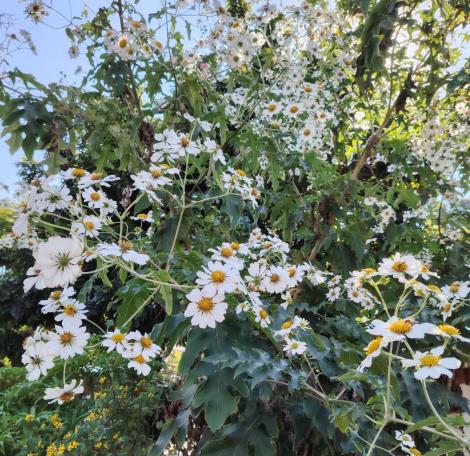
Mantanoa grandiflora
In addition to collecting leaves for our compost bins – a labour-intensive but satisfying task – we have been potting up the spring bulbs in pots and in the garden. We can comfort ourselves with the knowledge that those bare patches are where bulbs are developing underground. Lovely…
IN THE NURSERY
Click here to view all the plants in this newsletter on one website page.
Indigenous plants
The lemon thorn Cassinopsis ilicifolia is a dense spiny evergreen shrub that grows on average 3m high, making it a good screen. The small whitish flowers in spring are followed by large orange berries in autumn that birds love. It likes shade to semi-shade. We have them in 5 litre bags.
Only discovered in the Kranzkloof Nature Nature Reserve in 2000, Metarungia pubinervia is something for the rare plant collector. A well-shaped approximately 1.5m high evergreen shrub, it produces tubular red flowers on the upper side of branches from winter to spring that attract sunbirds and insects. Indigenous to the Durban area, it likes shade to semi-shade.
The dainty star-shaped feathery-edged yellow flowers of the rare Nymphoides thunbergiana are an absolute delight from summer to autumn. The large flat rounded floating leaves act as a habitat for juvenile fish. A fast-growing semi-hardy deciduous aquatic perennial, it does best in full sun.
The forest lily Veltheimia bracteata hails from the Eastern Cape. This is a lovely hardy summer deciduous bulb with glossy fleshy leaves and dense racemes of tubular pink flowers much loved by birds from winter to spring. Plant in shade to semi-shade.
Exotic plants
Scabiosa atropurpurea is an upright evergreen self-seeding perennial with deeply lobed leaves and wiry stems with rounded plum-coloured flowers from spring to autumn. It is hardy, grows on average 1m high, and likes sun and dry sandy soil.
Farfugium aureomaculata, on the other hand, is happiest in moist soil and even deep shade. An evergreen hardy clump-forming perennial, the leopard plant has glossy round yellow-spotted leaves and yellow daisy-like flowers in autumn. It reaches a height of about 60cm.
Geum Fresh woods is a compact perennial with a round cushion of coarse leaves and spikes of open orange flowers in summer. Evergreen and very hardy, it grows on average 50cm high and likes sun to semi-shade.
Just as a reminder that winter doesn’t last forever, I would like to sell our Hyacinthoides hispanica (Spanish bluebell) plants when they sprout. This robust deciduous perennial bulb has broad leaves and erect stems with bell-shaped violet flowers in spring. We have them 12cm pots.
SNIPPETS
Diehard fans will already know this, but for those who don’t, the Aloe Farm’s yearly Aloe Festival is scheduled for 22 June to 5 July. The farm is worth a visit for so many reasons beyond the aloes!
What a turnout at the voting station in the park next door to us. Fortunately, I decided to close the nursery for the day – there would have been no parking for our customers!
Happy gardening!
Leoné
082 482 0257