
Plectranthus flowering time is one of the many blessings of autumn. Anyone with even just one specimen of this shade-loving genus will be enjoying the display the heralds the end of summer.
There is an interesting story about one particularly lovely and rare variety, Plectranthus oertendahlii.
This plant is endemic to a small area from the Oribi Gorge to Uvongo in KwaZulu-Natal but was grown in Europe long before its wild origin was known. Nobody knows how and when it ended up in Sweden, but descriptions of it in that country date back to before 1924. It is named after Ivan Anders Oertendahl, the head gardener of Uppsala University Botanical Garden at the time and has the common name of Swedish ivy. It was ‘officially’ found in the wild by Hugh Nicholson and Rudolf Strey in 1971, although it is also known that Lillian Britten, a Botany lecturer at Rhodes University in Grahamstown, cultivated a herbarium specimen from a plant collected in the Oribi Gorge in 1936.
With its silver variegated leaves on purplish stems and delicate white flowers, this really is one of the prettiest Plectranthus varieties, particularly in a hanging pot. A word of warning, though. Perhaps in line with its quirky botanical history, it has a tendency to suddenly up and die, so it is well worth keeping a few cuttings going to fill the gap!
IN THE GARDEN
Autumn is such a lovely time in the garden. This year we have had the added bonus of some good rain early in April. The garden is celebrating the cooler weather (as are we) and everything is a tad overgrown, so I just know that – against all advice and “rules” - I am going to be doing an early winter / late autumn prune.
We are also planting a few loads of special plants that have been standing around for months. I cannot wait to see what the collection holds. A few years ago, Sheryl Berry gave me some orange ranunculus bulbs and what a picture they were. They have become one of my must-have plants for the autumn garden.
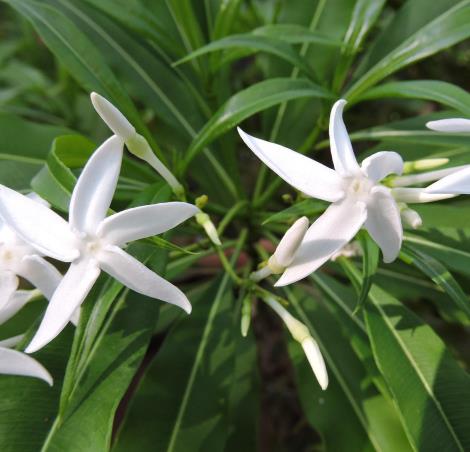
Alstonia venenata
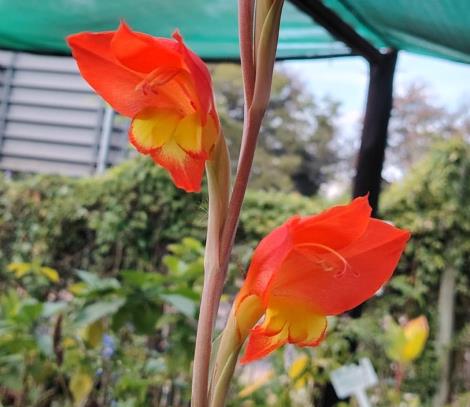
Gladiolus dalenii
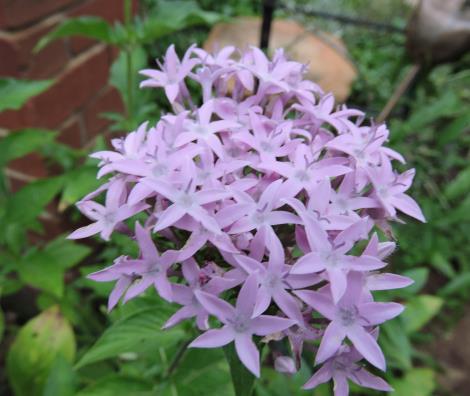
Pentas - pale pink
IN THE NURSERY
Click here to view all the plants in this newsletter on one website page.
Indigenous plants
With the lovely common name of traveller’s joy, Clematis brachiata is a vigorous deciduous creeper whose masses of fragrant creamy white flowers attract bees in autumn. Deciduous and very hardy, it can reach a height of 6m and likes semi-shade. Take note – it spreads rapidly!
Pycnostachys urticifolia (or hedgehog sage) is a good choice if you are looking for some colour in the winter garden. With its broad leaves and dense spikes of purple-blue flowers, this fast growing multi-stemmed shrub makes a good accent or hedge plant about 1.5m in height. Plant in sun to semi-shade.
Indigenous to the Drakensberg, Talbotia elegans likes shade and moist soil. A slow growing perennial which makes a good container plant, has creeping fibrous rosette-forming leaves and star-shaped coconut scented white flowers in summer. It is evergreen and very hardy, and grows about 25cm high.
The clump-forming Scabiosa africana – pink is a very hardy evergreen perennial with rosettes of deeply lobed leaves and large pink pom-pom flowers that attract butterflies from spring to autumn. Reaching an average height of 75cm, it is happy in sun or semi-shade.
Exotic plants
Echinops ritro is a tough deciduous perennial that likes dry sandy soil and sun to semi-shade. Growing about 60cm high, it has spiney woolly dark green leaves and rounded steel blue flowers from summer to autumn that attract bees and butterflies. A good cut flower.
Clerodendrum splendens has large oval wrinkled dark green leaves and terminal panicles of scarlet flowers which are splendid indeed! This strong growing woody climber indigenous to Western Africa is evergreen and hardy, and grows on average 3m high.
The superb Penstemon digitalis has creamy pink tubular flowers and lance-shaped toothed ruby red leaves on black stems. A clump-forming summer flowering deciduous perennial, it grows about 60cm high and likes sun to semi-shade.
If waterwise is a priority for you, consider the fast growing tree germander, Teucrium fruticans. This very hardy evergreen shrub has small glossy pointed aromatic silver leaves and little pale blue lipped flowers all season. Plant in full sun and dry sandy soil, and it will happily grow to about 1.2m in height.
SNIPPETS
I’ve said it before and I’ll say it again – don’t forget to take advantage of all those falling leaves. Collecting leaves for our nursery bins is one of our favourite pastimes; also one of puppy Katie’s as it turns out! We binned our first leaves of the season this week.
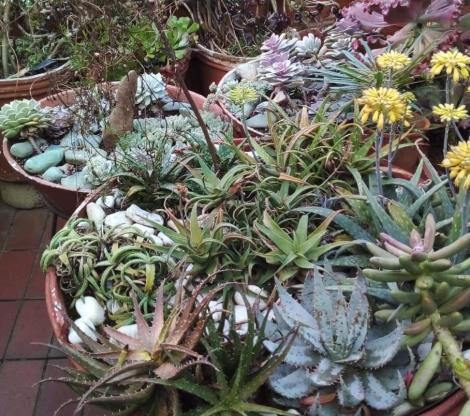
Lucette Wegelin has been collecting succulents for many years and unfortunately now has to sell her superb collection. The plants are beautifully planted and displayed in large flat garden pots which she is selling for R400 each. Lucette is in Pretoria and can be called or contacted via Whatsapp on 072 968 7500.
Happy gardening!
Leoné
082 482 0257