
An entertaining and informative blog post by Monique Allen of The Garden Continuum prompted me to devote this newsletter to one of gardening’s most humble and generally least popular activity – weeding. Let’s face it, even for those who consider rootling around in the soil a pleasant pastime, weeding will at times definitely qualify as a chore.
Proper tools and a little planning can make a big difference when you can’t put a cleanup off any longer. As Monique bluntly puts it, “weeding is digging.” In other words, just yanking at some leaves or stems is not going to do it; you have to get the whole plant out, including – and especially – the roots. Easier said than done when you are dealing with a white stinkwood seedling that should have been pulled out a couple of months ago! Those tap roots require a grubber or hand weeder that can really get in there.
Timing is the secret from a planning point of view. Weeding is going to be a whole lot easier if you get stuck in after some rain (or a good watering) has loosened up the soil for you. You also want to get weeding done before unwanted plants flower and set seed. Monique explains that “soil can hold years and years and years of seed, so making further deposits [in that seed bank] only ensures that these weeds will come endlessly, year after year.”
But perhaps discernment is also an important component of planning. For one thing, a plant which shows up unexpectedly may be what some garden fundis rather charmingly call a ‘volunteer.’ It may be the offspring of perfectly acceptable trees, shrubs, perennials or annuals that you or your neighbours planted. At the very least, you could think about transplanting it to a spot where it will better serve your garden design or potting it up to give to friends. Secondly, many plants labelled weeds because of how they proliferate used to be respected for their medicinal properties by our mothers or grandmothers. Take a little time to research the uses of the humble dandelion or plantain, for example, before summarily yanking them out.
Wayne Dyer is credited with saying, “the difference between a flower and a weed is judgment.” Perhaps the general view that any plant you didn’t put in yourself is a weed calls for a little more thought?
IN THE GARDEN
It occurred to me the other day that although we think of July as a rest month in the garden, it is actually the busiest time of the year for the gardener! Granted, the extremely cold weather has kept us indoors or on light duties, but over the next two weeks we will get back to relocating shrubs and perennials that need more space, and get going with the pruning which should have started two weeks ago. We will also be lifting and splitting plants like kniphofias, daylilies and campanulas for the nursery.
I have been through the whole garden and cannot find one deciduous shrub that is starting to sprout. Isn’t nature clever!
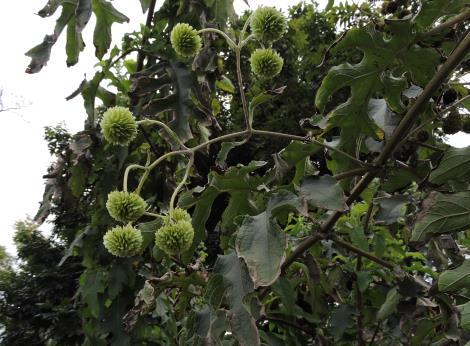
The lovely seeds of the Montanoa - as pretty as the flowers!

Salvia iodontha

A lonely white Cistus bloom

One of our newly wrapped shade houses
IN THE NURSERY
Click here to view all the plants in this newsletter on one website page.
Indigenous plants
The scented red tubular flowers of Cyrtanthus mackenii are one of the highlights of the winter garden. A bulbous clump-forming perennial indigenous to KwaZulu-Natal and the Eastern Cape, the red ifafa lily is evergreen and very hardy, grows about 25cm high, and wants full sun. It is a good cut flower.
Pelargonium tomentosum is a sprawling evergreen perennial with attractive scented velvet-textured leaves and delicate white flowers in summer. It reaches an average height of 50cm and likes semi-shade and moist soil.
Scabiosa Africana – blue remains a favourite. An evergreen and very hardy clump-forming perennial, it has rosettes of deeply lobed leaves and blue/lilac flowers from spring to summer – although ours are flowering now in mid-winter! It reaches an average height of 60 cm and wants full sun.
Selago canescens grows about 1.2m high, and has dense tufts of short narrow leaves and tight clusters of mauve flowers that attract butterflies in spring. This hardy evergreen upright shrub is indigenous to the Western Cape region up to Port Elizabeth, and likes full sun and dry sandy soil.
Exotic plants
The New Zealand rock lily, Arthropodium cirrathum, is a rather gorgeous tufted perennial with lance-shaped, grey-green leaves and panicles of star-shaped white flowers in summer. Evergreen and very hardy, it grows about 75cm high and likes sun to semi-shade, although it also grows well in dry shade.
Bletilla striata puts out its lovely sprays of pink/lilac flowers in early spring, so it is just the thing for those of us who can’t wait for the flowering season to start. Ours are just beginning to push out their first buds. This hardy clump-forming terrestrial orchid is deciduous and should be kept dry in winter, then divided in early spring. Plant in semi-shade.
Mansoa alliacea is an evergreen, semi-hardy twining vine with garlic-scented bright green leaves and sprays of tricolour lavender flowers in spring and autumn. It grows about 2.5m high and likes sun to semi-shade.
We cannot get to the end of winter without having featured Tradescantia - Blushing Bride in a newsletter. This very hardy evergreen trailing groundcover has small pink flowers in summer but it is the green, cream and purple colour differentiation of its leaves that make it such a worthwhile addition to the garden – particularly in winter when the differentiation is most prominent. Plant in sun or semi-shade, and cut back for even more colour differentiation!
SNIPPETS
Perhaps like us you are working your way through bags and bags of oranges at the moment. This seemed like an opportune time to share our ant deterrent which basically consists of steeping 1 kg of orange peels in 5 litres of water for a week. We spray this throughout the season whenever we have an infestation of ants.
Happy gardening!
Leoné
082 482 0257