
Pierre Marais has been my go-to man for reasonably priced, quality fertilisers for a number of years. Pierre is rather a low key chap who markets himself and his products the old-fashioned way – through word of mouth and giving talks – but I know I am not the only commercial plant grower who trusts his knowledge, advice and products. A recent conversation with him turned to container planting and he offered to send me some notes he has used for talks on the subject. What an interesting read! I have extracted some main points to include in the newsletter, but you can click here if you would like to read his full notes. (See the note under Snippets.)
Pierre doesn’t mince his words on the topic of drainage: “If a container doesn’t have drainage holes at the bottom, it was not made to have a living thing planted in it.” To ensure that excess water can drain away, a container must have drainage holes and be lifted slightly off the ground if it is positioned on a soft surface like soil or mulch. Interestingly, he gives a quite scientific reason for NOT placing things like broken clay pot pieces at the bottom of the container, saying that if you use the right kind of growing medium, drainage holes will never get blocked.
On the point of growing medium, Pierre is again fairly blunt: “Topsoil or normal soil that you can get by the spade load from your own garden or the construction site down the road does not belong in a container that contains a live plant.” Potting soil with good air-filled porosity will promote drainage and ensure that there is enough oxygen in the rootzone of the plant.
Knowing when to water container plants is a knack that comes with experience because it is not always easy to tell whether a wilting plant is thirsty or suffering from root rot due to over-watering. The top layer of soil is also not a good indicator of overall moisture. Pierre suggests rather “getting a feel” for the weight of a completely dry and completely wet container. In terms of how much water to give a plant, the golden rule is to water until you see water coming out through the drainage holes.
Of course, Pierre’s full notes include the matter of nutrition but I want to get more details from him on this topic for a future newsletter, so watch this space.
IN THE GARDEN
The focus at the moment is on protecting our plants from the cold (so far, so good!) and general maintenance in the nursery. I have eventually bought a plastic cold protector for the shade houses – something I should perhaps have done years ago.
Some shrubs that have outgrown their allotted spaces have been moved, and we have filled in some of the bare patches. Next week, we start our annual pruning which always stirs the heart a little as it means starting to look towards spring!
There is always a little something to enjoy in the garden, even if it is winter.
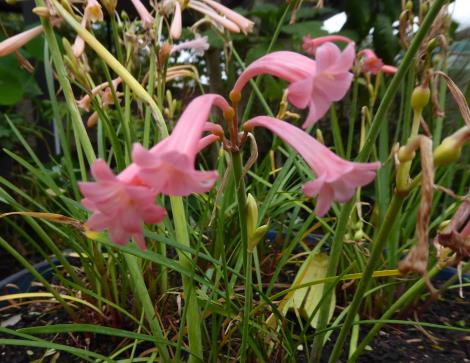
Cyrtanthus mckennii
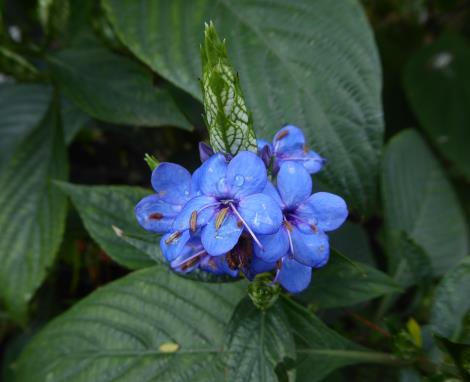
Eranthemum pulchellum
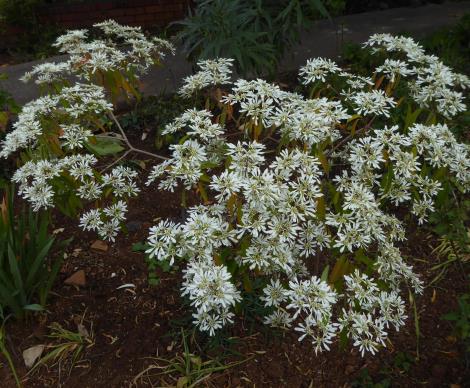
Winter flowering Euphorbia
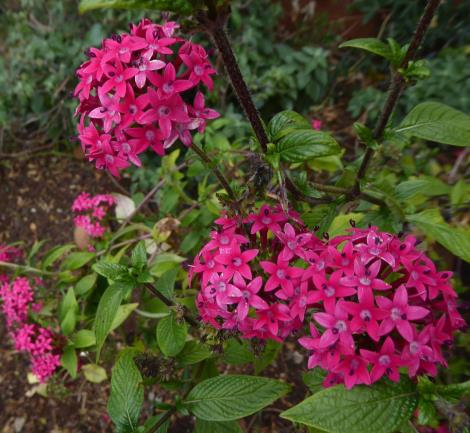
Penta cerise pink
IN THE NURSERY
Click here to view all the plants in this newsletter on one website page.
Indigenous plants
Bulbinella nutans is a rare deciduous clump-forming bog perennial with narrow fleshy leaves, and dense racemes of yellow flowers from winter to spring. It is hardy, reaches a height of about 1m and likes semi-shade. Bees love it and it makes an excellent cut flower.
The threatened climber Mondia whitei is a robust grower with thick red veined leaves and clusters of interesting red and white flowers in summer. Indigenous to the forests and reverine woodlands of KZN and Limpopo, it likes moist conditions and shade to semi-shade. It is evergreen and semi-hardy, and grows about 5m high.
Pycnostachys urticifolia (with the more pronounceable common name of Hedgehog Sage) is a fast growing approximately 1.5m high shrub that makes a good accent or hedge plant. Evergreen and hardy, it has dense spikes of true blue flowers from autumn to winter. Plant in full sun.
Senecio macroglossus is a hardy evergreen ivy-leafed climber which bears dainty pale yellow daisy-like flowers all year but is especially floriferous in late winter and spring. It grows about 2m high so needs a support to climb, and is also happiest in semi-shade. We have plants in 18cm pots.
Exotic plants
Abutilon megapotamicum is a very hardy evergreen shrub with arching shoots and very striking bell-shaped red flowers with yellow tips all year. As it can grow 1.2m high, I grow it on an obelisk or trellis or trailing down a wall, but it is easy to shape as you like. Plant in sun or semi-shade.
Another plant well suited to growing over an arch, trellis or fence is Fuchsia - Lady Boothby. This is a tough 2.5m climber with dark green leaves and dangling red and purple flowers from summer to autumn. Evergreen and very hardy, it likes semi-shade.
Salvia karwinskii is an upright shrub with rough leaves and spikes of two-lipped scarlet flowers from winter to spring. Evergreen and hardy, it grows about 1.8m high. Plant in moist soil and sun to semi-shade, and prune regularly.
If you’re looking for a touch of drama during winter, you can’t do better than the chalice-like flared yellow flowers of Solandra maxima, more commonly known as Cup of Gold. A vigorous woody evergreen hardy exotic climber with dark green glossy leaves, it grows up to 5m high and likes sun to semi-shade.
SNIPPETS
Pierre’s helpful advice about container gardening has prompted the addition of a new page to the website called QI (Quite Interesting) – for want of something better. Does anyone have suggestions for a catchy title? Information and hints that are a bit too long for newsletter purposes will be added to the page as we go along.
Happy gardening!
Leoné
082 482 0257