
Impromptu visits by eminent and interesting people regularly add sparkle to life at Petal Faire. During a recent one, I got to browse through glorious photographs of some of the work my visitor has been doing with world-renowned Dutch garden designer, Piet Oudolf. My enduring love for herbaceous borders was instantly resurrected, and our March newsletter was in the bag.
The artfully designed mixed beds of largely annual or deciduous plants that still grace stately country homes in the UK can be as daunting as they are inspiring. But good friend and doyenne of the South African garden design scene Shirley Wallington assures me that the herbaceous border is alive and well in South Africa - with tweaks to accommodate our local plants and the fact that few of us have a fleet of gardeners to handle the endless replanting.
The main principle is to combine plants of different heights, textures and colours in a way that creates a pleasing overall picture. Repetition is key. Feature plants are placed a few metres apart to create the effect of clumps or ‘ribbons.’ Shirley likes to use similar colours together, such as white, blue or pink. Another defining characteristic of the herbaceous border is that taller plants are positioned in the back with progressively shorter ones towards the edge of the bed.
.jpeg)
Waltham Place
Some deciduous plants can be incorporated but if the thought of bare patches for some months of the year is too much to bear, stick to evergreens. Some of my recommendations? A few grasses, short leonotis, salvias, aristea or Louisiana iris, and some large leafed perennials like phlomis, or even ligularias…
As an aside, when I asked about a glaringly bare spot in one of the photos we were going through, I was told that it was where a ‘design mistake’ had to be dug up. How nice to know that even the experts don’t always get it right!
IN THE GARDEN
Many years ago, I bought a ylang ylang tree, Cananga odorata, planted it in the garden, and watched it die a sudden death. Subsequent plants bought for the nursery also did not survive our winter cold.
Then about ten years ago, Martin Smit, the curator of the Stellenbosch Botanical Gardens at the time, paid us a visit and brought along a ylang ylang climber (Artabotrys hexapetalus). I was very sceptical but thanked him profusely. After nursing it through a few winters, we just let it be, and guess what – it started to shoot out and look quite good. We finally planted it out in the garden last spring.
Yesterday on a walkabout, I noticed rather funny looking growths on the plant. Yes, our climbing ylang ylang is in bud! The staff are madly doing cuttings and we are holding thumbs that they will grow. I will definitely put some pics on Facebook. Such excitement!
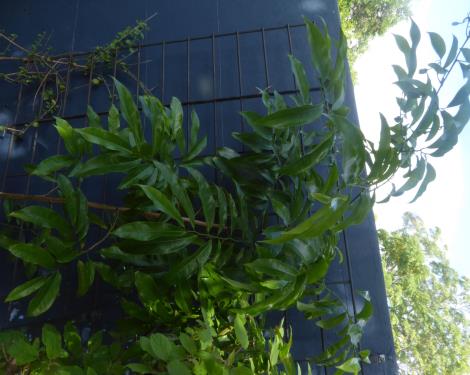
Our ylang ylang climber
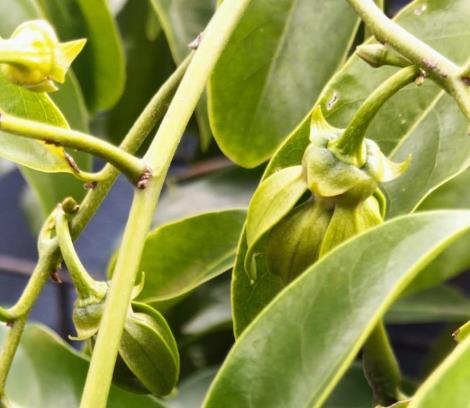
The cause of all our excitement
And elsewhere in the garden...
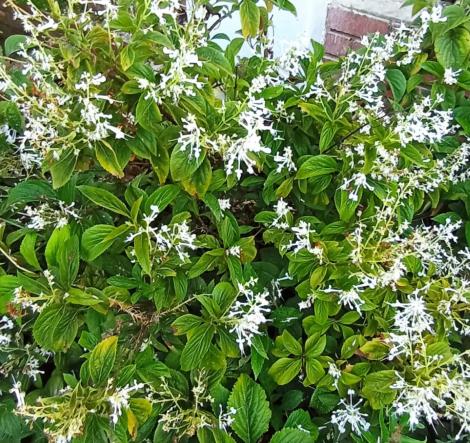
Plectranthus ecklonii white
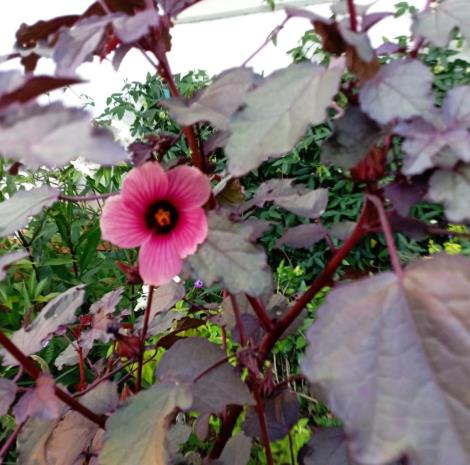
Hibiscus acetocella
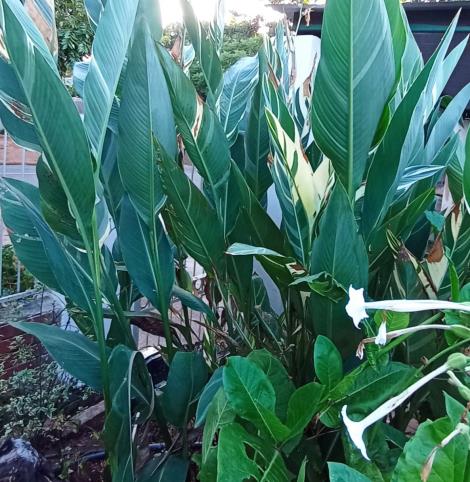
Canna Stuttgart
IN THE NURSERY
Click here to view all the plants in this newsletter on the website.
Indigenous plants
Barleria albostellata is an upright evergreen shrub that reaches an average height of 150cm and has gorgeous big furry leaves and large white flowers in summer that attract bees and butterflies to the garden. Indigenous to tropical and subtropical woodland areas, it likes sun to semi-shade. We have plants in 5 litre bags.
An interesting tough perennial that likes full sun and grows in colonies in poor sandy soil, Platycarpa glomerata has a basal rosette of spiny toothed leaves and stalkless pink flowers from spring to summer. It grows only about 30cm high.
Plectranthus ciliatus aurea is a very hardy evergreen creeping perennial with attractive golden toned quilted leaves and spikes of blue flowers in autumn. Like most plectranthus species, it wants shade to semi-shade.
For the succulent lovers out there, Senecio rhomboideus is a must. A gorgeous deciduous succulent with elongated tubers and large toothed grey green leaves, it has sprays of yellow flowers in summer. It reaches a height of about 100cm and wants full sun.
Exotic plants
Aristolochia gigantea is an unusual vigorous evergreen climber with broad triangular dark green leaves and huge veined maroon and brown flowers with white markings from summer to autumn. It reaches about 5 metres on average and likes sun or semi-shade. Long flowering period.
A marginal bog plant with rhizomes that produce kidney shaped toothed leaves, Caltha palustris has vibrant waxy yellow flowers that are a must around a pond. Evergreen and very hardy, it grows about 120cm high and flowers from spring to summer. It can take sun to semi-shade but needs up to 10cm of water above the crown of the plant.
The lovely Sisyrinchium palmifolium is a plant that wants full sun. This is an evergreen clump forming perennial with blue green straplike leaves that grows about 75cm high. Its flat stems bear large yellow saucer-shaped flowers in summer.
Symphytum tauricum (Crimean comfrey) makes a good non-invasive groundcover for moist, even deeply shaded parts of the garden. A very hardy evergreen clump forming perennial with tuberous roots and oblong green leaves, it has pretty tubular white flowers in summer.
SNIPPETS
After optimistically referring to the balmy days of autumn in our last newsletter, we are still waiting. Summer seems unwilling to let go this year, but sooner or later…
Happy gardening!
Leoné
082 482 0257