
How lucky we are in South Africa to have the glorious blossoms of the hydrangea to bring inside to grace our festive tables! We are even the only country that affectionately refers to these beautiful perennials as ‘krismisrose’ (Christmas roses).
Hydrangeas have much to recommend them: a long flowering season, robustness and longevity, old-fashioned charm. Being able to play with the colour of the blooms by adjusting the acidity of the soil is an added benefit. When it comes to care, there is only one non-negotiable – water, water, water. Fortunately, hydrangeas also want some shade where conditions are generally moist, but further to that, you can think of planting them where there is a regular or at least automatic water ingress from gutters or even baths, washing machines or sinks.
A hydrangea in a happy spot is likely to flourish with very little attention, and perhaps even become too large. Harsh pruning should be avoided, however, so make it a habit to cut back dead, diseased or broken branches every year. We have Oakleaf hydrangeas (H. quercifolia), Bigleaf hydrangeas (H. macrophylla), and Mountain hydrangeas (H. serrata) in South Africa. These are Group 1 plants, which means they bloom on last year’s growth and should be pruned in late summer when flowering has stopped. If you trim in autumn, winter or spring, you could cut off new buds. That said, pruning the tips of branches as the leaves emerge in spring can encourage multiple, smaller flowerheads.
We have a wonderful selection of hydrangeas in the garden and have undertaken to get them rooted and in pots for next season. Watch this space!
IN THE GARDEN
This is still such a happy time in the garden – plants performing so well, lush growth and lots of blooms. We have also had wonderful rains in the last six weeks, including some rogue thunderstorms and then hail which wreaked havoc on the soft-leafed plants like the water lilies and begonias. But as with life, we take the knocks and know that everyone will recover over the next few weeks.
In addition to our dogs and Seabright bantams, the garden is currently playing host to a clutch of baby robins in a nest and (unfortunately) a mongoose that is terrorising our chicks. I haven’t seen one here before but no doubt the scent of tasty young morsels lured him out of hiding. All in all, we are being kept quite busy!
.jpg)
Alstonia venusta
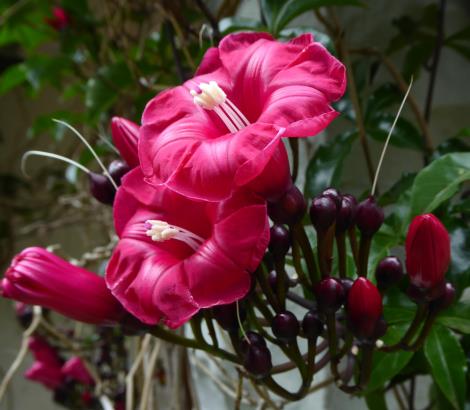
Ipomoea horsfalliae
_rsz.jpg)
Hydrangea quercifolia

Quisqualis - a feast for the eyes and nose at our gate
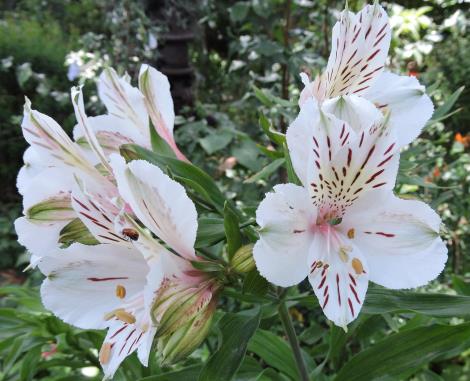
One of the stars of the garden at this time of year - Alstroemaria
IN THE NURSERY
The nursery is full of such an exciting selection of plants, even I get excited when I look around!
Click here to view all the plants in this newsletter on the website.
Indigenous plants
Aristea angolensis is a fast growing evergreen perennial with a basal fan of tufted narrow leaves and spikes of pale blue flowers that attract butterflies in spring. It grows about 90 cm high and can take sun to semi-shade. A hardy plant, it is indigenous to Gauteng, Mpumalanga and the Drakensburg.
The scrambling perennial Barleria gueinzii is just coming into flower and will bloom into autumn Evergreen and hardy, it has soft hairy grey green leaves and spikes of pale blue flowers which attract insects and butterflies.
Dimorphotheca jucunda is an unusual evergreen and very hardy highveld perennial. Around 50 cm in height and with its while daisy-like flowers from spring to summer, it is well suited to rockeries and mass planting. It wants full sun.
The tufted grass Stipa dregeana is a self-seeding perennial with lax clumps of lime green leaves and panicles of golden spikelets in summer. Evergreen and hardy, it reaches a height of about 50 cm and is a host plant for butterflies. It can take sun or shade.
Exotic plants
The red Chinese hat plant, Holmskioldia sanquinea, is a tall upright deciduous shrub with arching stems and slender pointed ovate leaves and trumpet-shaped red flowers. Waterwise and hardy, it makes a good hedge or specimen plant. It grows about 2 m high, and likes a sunny position with dry, sandy soil. Plant now for a spectacular display in autumn and winter
Neomarica caerulea is a large rhizomatous perennial that likes semi-shade and moist soil. With its gorgeous scented dark blue brown-centred flowers from spring to summer, it works well in a mixed border or as an accent plant. Evergreen and hardy, it reaches an average height of 1.6 m.
The purple black flowers in pale green calyxes are what make the Andean silver leaf sage, Salvia discolor, really special. Native to Peru, this multi-stemmed perennial has max stems and furry grey leaves, and flowers from summer to autumn. It is evergreen and hardy, and is happy in sun to semi-shade. It grows about 50 cm high. Loved by birds and butterflies.
We have a number of nymphaea hybrids in a variety of colours in stock. Water lilies flower from summer to autumn, so now is the time to buy for a lovely display in your pond or water feature. Click here for our page with more information and a list of cultivars.
SNIPPETS
All at Petal Faire wish you and yours a happy and peaceful festive season! Remember that we offer gift vouchers and will be open over the holidays (see here for our business hours).
Happy gardening!
Leoné
082 482 0257