
When the idea arose of dedicating this newsletter to grasses, my mind turned to the incomparable Dutch landscape architect Piet Oudolf. If you don’t know who he is, Google New York City’s High Line and the Lurie Garden in Chicago’s Millenium Park. You will never see gardening the same again!
Oudolf embraces the perennial nature of a garden through the seasons, and uses grasses, not as a filler, but as what he calls a “visually quiet” tool that holds a garden together. They provide year-round interest in the garden, framing the highlights of seasonal flowers.
My dear friend Paul Clarke loves using grasses in his landscape designs because he believes they do a few things that nothing else can.
They make a garden feel natural – perhaps even a little wild – but still intentional. He also loves the way grasses catch the light (especially in early morning and late afternoon), soften stronger forms without sacrificing shape, and add movement – “even a slight breeze brings the whole garden to life.” These are some of his indigenous favourites:
- - Melinis nerviglumis gives a soft pink haze.
- - Melinis repens is lighter and more scattered, and has a slightly scruffy pink flush that catches the light beautifully.
- - Themeda triandra offers seasonal coppery red colour.
- - Eragrostis curvula is a robust grass with a graceful weeping habit.
- - Aristida junciformis has conspicuous mauve plumes in summer, and adds texture like nothing else quite does.
For something more showy, there is the exotic fountain grass Pennisetum setaceum 'Rubrum' with its dark foliage and arching deep pink plumes.
Much as my heart lies with the floriferous gardens of England, I must confess that the occasional swathes of stipa dregeana are one of my favourite things in our garden!
If you would like some advice or help with introducing grasses to your garden, you can contact Paul on 082 807 3322.

One of Paul's beautiful garden designs
IN THE GARDEN
Cooling temperatures not only signal the coming of winter but the time to start planting! Planting in autumn is ideal because the still warm soil encourages rapid root growth, while cooler air temperatures reduce the heat stress on plants. This allows plants to establish strong root systems before winter dormancy, leading to healthier, more drought-resistant, and earlier-blooming plants the following spring.
I have just been told that our beautiful oak tree in the nursery is infected with shot hole borer. I could see that her growth pattern had suddenly changed – dead branches and earlier dropping of leaves. We will really mourn her passing.
There is at least still a fair amount of colour and texture to enjoy in the garden.

Abutlion - Jenny's Pink
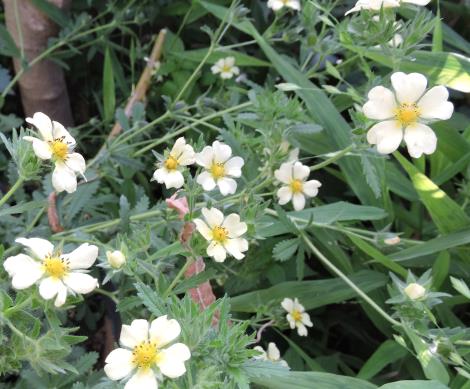
Potentilla recta
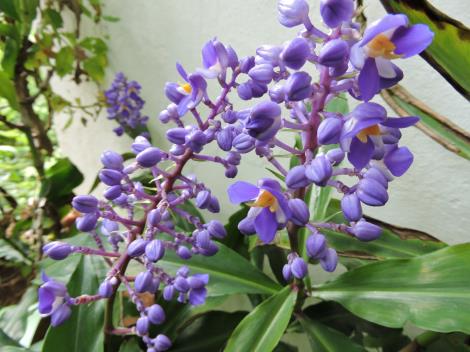
Dichorisandra thyrsifolia
IN THE NURSERY
Click here to view all the plants in this newsletter on one website page.
Indigenous plants
Bauhinia natom is a rounded evergreen shrub with roundish two-lobed green leaves that can grow up to 5m high. The scented cream cup-shaped flowers from spring to autumn attract moths and butterflies. Plant in a sunny spot.
A March newsletter would not be complete without mentioning at least one plectranthus. The rounded perennial Plectranthus ambiguus has pointed, grooved, slightly wrinkled leaves, and sprays of violet/blue flowers in autumn. These plants are lovely planted en masse in the semi-shade. They grow about 60cm tall in my garden.
The very endangered Natal ginger, Siphonochilus aethiopicus, is a rhizomatous semi-hardy deciduous perennial with lance-shaped light green leaves and gorgeous fragrant orchid-like pink flowers from spring to summer. Its roots are known to have medicinal properties. This is a plant that wants shade to deep shade.
We have the Stipa dregeana mentioned in our story above in stock. A tufted self-seeding evergreen grass with lax clumps of lime green leaves and panicles of golden spikelets in summer, it is not only simply lovely in the garden but also serves as a host plant for butterflies. It is happy in sun or shade.
Exotic plants
Geum - Fresh Woods is a compact clump-forming evergreen perennial with a round cushion of coarse leaves and spikes of open orange flowers in summer. It is happy in sun to semi-shade.
The waterwise mock orange, Philadelphus coronarius, is equally lovely as a specimen plant or in a border with dry, sandy soil. A fast-growing upright deciduous shrub that grows on average 2m high, it has bell-shaped scented white flowers in summer. We have huge plants in 5 litre bags.
Salvia greggii Amethyst lips is a new addition to the nursery. This very hardy evergreen perennial has pretty whorled spikes of white flowers with purple tips from summer to autumn, and reaches an average height of 75cm. Plant in full sun.
Tricyrtis formosana is a clump-forming rhizomatous evergreen hardy perennial with spotted lance-shaped leaves and gorgeous star-shaped orchid like lilac flowers in autumn. It grows about 80cm high and wants acid soil and semi-shade. An old favourite that never loses its charm.
SNIPPETS
Tokara Wine Estate once again opens its private farm garden for the annual Rare Plant Fair & Autumn Open Garden on Saturday, 18 April 2026. Specialist growers will offer a carefully curated selection of indigenous fynbos, proteas and unusual specimens ideal for autumn planting. Entry is R60 per person (children under 10 free), with proceeds going to Camphill Farm Community in Hermanus, and you can pre-book a Tokara Delicatessen picnic hamper enjoy on the lawn.
FUN FACT
The toad lily (Tricyrtis) gets its name from the mottled, spotted appearance of its flowers, which resemble the warty, speckled skin of a toad. But the story also goes that an indigenous Filipino tribe called the Tasaday rubbed the scented, sticky juice of the plant onto their hands and arms before going frog hunting. The smell was said to attract frogs and the stickiness made it easier to catch them.
Happy gardening!
Leoné
082 482 0257