
Happy 2026, fellow gardeners! May we strive to create small corners of peaceful growth wherever we can.
I recently came across an article published by the BBC in July 2021 entitled “The argument for switching off lights at night.” It was depressing but fascinating and thought-provoking reading. As gardeners, we all know the importance of avoiding or at least minimising the use of poisons that harm the birdlife and insects that are an integral part of our micro-ecosystems. But light pollution is a more insidious way we impact the natural world without possibly realising it.
Artificial lights are considered a major reason for the deaths of millions of birds every year in the United States due to flying into buildings. What a brutally clear statistic to contemplate! But experts also link the global decline in insect populations to the pervasiveness of artificial light. Ruskin Hartley, executive director of the International Dark-Sky Association (IDA) says that "Every single creature that has been studied in terms of the relationship between light and those creatures' habits has found detrimental impacts.” There is evidence that the pervasiveness of artificial light in larger towns and cities affects the rhythm of night and day that gives plants and animals signals related to feeding, mating, migrating and navigating.
Sadly, with the levels of crime being what they are in our country, most find it difficult to consider having no outside lights on their properties, but I can vouch for the effect of darkness in the nursery at night. The air is positively alive with moths.
Paul Bogard – author of ‘The End of Night: Searching for Natural Darkness in an Age of Artificial Light’ – argues for simply using lighting “responsibly and intelligently.” Perhaps motion-sensor lights are worth another look?
IN THE GARDEN
Although the sun finally came out with what seems like some sense of purpose about three weeks ago, I haven’t gone as far as packing my winter woollies away! The plants seem to have coped with the lack of warmth and sunshine, but have they really? We are noticing many with yellowing leaves, especially in the nursery. Dosing them with citric acid hasn’t helped at all, so now we are going to try spraying them with a high nitrogen fertilizer. Holding thumbs.
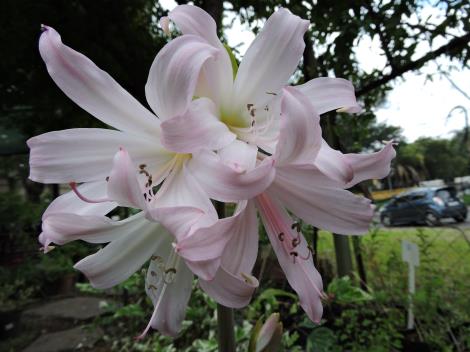
Amaryllis belladonna
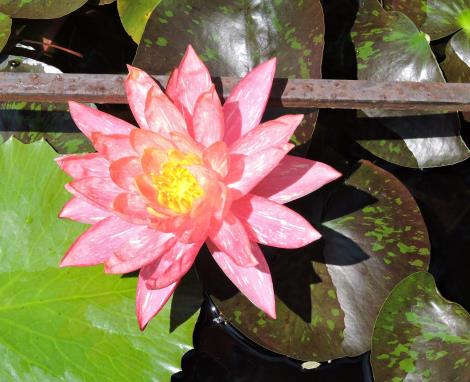
Nymphaea 'wanvisa'
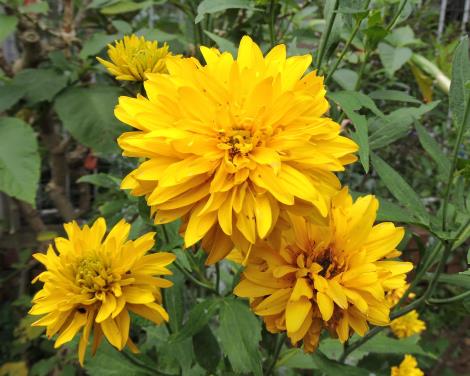
Rudbeckia Goldquelle
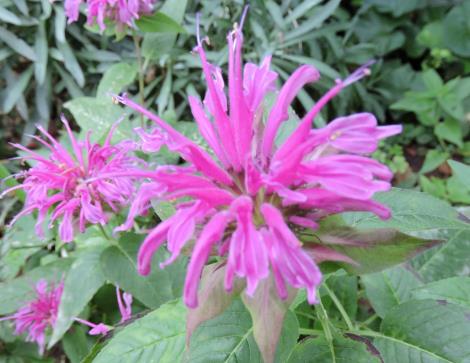
Monarda prairienacht
My friend Mike Viviers has scored many brownie points by gifting me a Romneya coulteri – a plant I have coveted for 25 years!
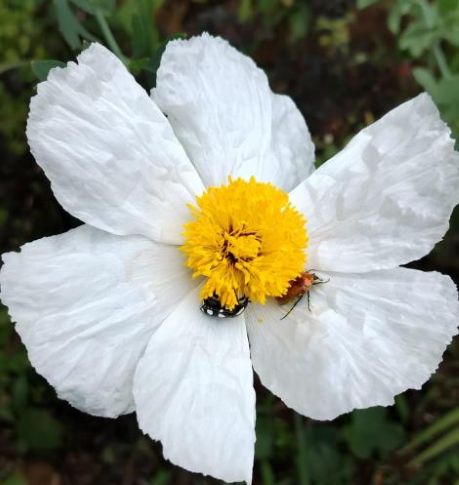
A gorgeous romneya coulteri bloom - with visitors!
We have the odd flower developing about once a week, and so far, there are three seed pods getting ready for harvest. Very exciting! No plants for sale in the nursery just yet, I’m afraid.
IN THE NURSERY
Click here to view all the plants in this newsletter on one website page.
Indigenous plants
Petalidium oblongifolium is a low-growing perennial shrub with veined oblong grey green leaves and pale blue flowers all year. It wants dry sandy soil, and although apparently perfect very sunny places, I have one thriving where it only gets morning sun. It grows about 60cm high.
The tough interesting perennial Platycarpa glomerata grows in colonies in poor sandy soil. With a basal rosette of spiny toothed leaves and stalkless pink flowers, it is a tough evergreen plant that flowers from spring to summer.
The yellow pea-like flowers of Rhynchosia pentheri attract butterflies from summer to autumn. This dainty evergreen twining climber with lovely trifoliate leaves grows about 1m high and prefers semi-shade.
Syncolostemon rotundifolia is a rare tough dense woody indigenous shrub endemic to Pondoland. With velvety white stems, small round grey-green leaves, and dense inflorescence of pink mauve flowers all season, this evergreen plant wants full sun.
Exotic plants
The Mayan tree spinach, Cnidoscolus chayamansa, is a 3m high upright leafy orphan food plant with huge palmately lobed dark green leaves. The cooked young leaves are nutritious and – according to orphan crop specialist Jason Sampson – much better tasting than other superfoods like moringa! Summer-flowering, deciduous and hardy, it can take sun to semi-shade.
Costus barbatus (the red tower ginger) is an upright evergreen perennial with dark green leaves that spiral around the stem, and a bold red cone with yellow corolla. The flowers (from summer to autumn) are edible. This is a hardy plant that can reach a height of 2m and is happiest in shade to deep shade.
Justicea aurea is another plant that wants even deep shade. This upright evergreen branched shrub with robust stems and huge mid-green leaves, has sprays of tubular yellow flowers in summer which attract bees and butterflies. It grows about 1m high and benefits from being cut back in early spring.
The clump-forming perennial Salvia leucantha - White has soft green lanceolate leaves and lovely sprays of woolly white flowers from spring and autumn. Evergreen and hardy to -10˚C, it reaches an average height of 1m and wants full sun.
Vitex agnus - castus alba is a very beautiful large shrub with elliptical toothed aromatic leaves and sprays of fragrant white flowers from summer to autumn. This medicinal plant is deciduous, grows on average 1.8m high, and is happiest in a sunny position. It flowers on new growth.
SNIPPETS
Cnidoscolus chayamanse is one of several food plants we now have in the nursery. If edible plants are an interest of yours, you can look forward to a newsletter dedicated to food plants soon!
As promised in our October newsletter of last year, forager Nikki Brighton will be at Petal Faire on 14 February from 9-11am to give a workshop on identifying and tasting edible weeds – aka uncultivated food. Entrance: R300.
FUN FACT
‘Orphan crops’ is the name for underutilised local plant species that are essential for food security, nutrition, and income for smallholder farmers in Africa and other parts of the world. Their high resilience to climate change, pests and poor soils has attracted the attention of organisations working to combat malnutrition.
Happy gardening!
Leoné
082 482 0257