
The savanna country of the Kruger National Park still fresh in my mind after a recent trip with family visiting from the UK, I have been thinking that there is something very lovely about stretches of uninterrupted grassland. Yes, we still have some savanna up here on the Highveld to give the eye a break between increasing built up areas, but Kruger’s grasses have a different quality, don’t they.
This excerpt from an address delivered in 1872 by John Ingalls, a United States senator from Kansas, is nothing short of an ode to grass. It was originally shared on Facebook by the Grassland Society of South Africa. For someone whose focus is so often on varieties, what grows where and how something works in garden design, his words really gave me pause.
Grass is the forgiveness of nature—her constant benediction. Fields trampled in battle, saturated with blood, torn by the ruts of cannon, grow green again with grass, and carnage is forgotten. Forests decay, harvests perish, flowers vanish, but grass is immortal. Sown by the wind and wandering birds, propagated by the subtle horticulture of the elements, it softens the rude outline of the world. Its tenacious fibres hold the earth in place and prevent its soluble contents from washing into the sea.
Grass invades the solitude of deserts, climbs inaccessible slopes and forbidding mountain peaks, modifies climates, and determines the history, character and destiny of nations. Unobtrusive and patient, it has immortal vigour. It bears no bloom to charm the senses with fragrance, but its homely hue is more enchanting than the lily or the rose. It yields no fruit in earth or air and yet, should its harvest fail for a single year, famine would depopulate the world.
IN THE GARDEN
Hot hot hot – it felt like the heatwave would never break, but of course it eventually had to (more or less). I am constantly amazed at how resilient our garden plants are in conditions that we might find unbearable. Whether it is the coldest winter or the hottest summer, they seem to be able to take things in their stride. Another positive of the intensely hot days has been the mesmerising scent in the garden in late afternoon.
It has still been wonderful to go out in the early morning and evening to enjoy how the colours change as we move into high summer. Our Inca lilies, hydrangeas and climbers continue to lift the spirits.
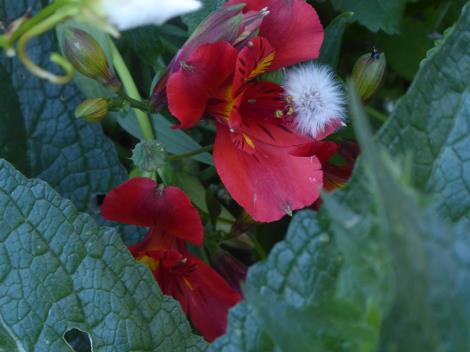
Maroon Alstromaria (among the weeds)

Molly having a sniff at the Nepeta
.jpg)
The ever gorgeous Quisqualis
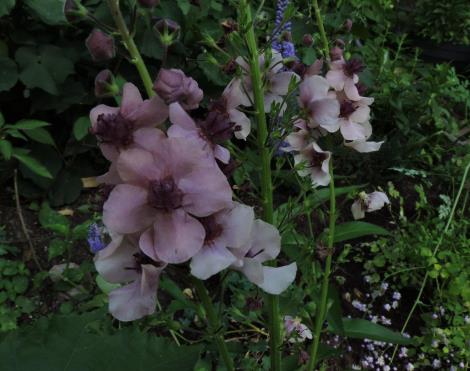
Pink Verbascum
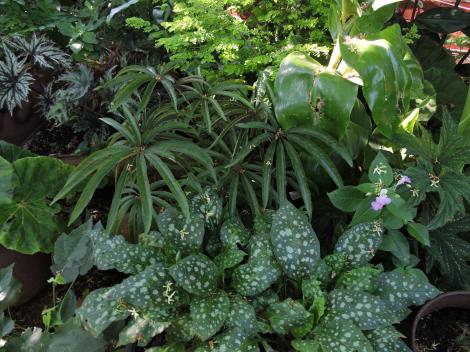
The varied joys of a shady garden
IN THE NURSERY
Click here to view all the plants in this newsletter on one website page.
Indigenous plants
Ochna barbosae is a slender approximately 3m high deciduous woodland shrub with scented yellow flowers in spring followed by pinkish fruits. More robust than Ochna serrulata, it attracts birds and butterflies. Plant in sun or semi-shade and dry sandy soil.
With its creamy variegated frilly leaves and large clusters of small scented yellow flowers in autumn, Senecio tamoides variegate is a very attractive fast-growing climber for semi-shaded areas of the garden. It is hardy and also grows about 3m high.
Solanum africanum is a scrambling climber with narrow lance-shaped dark green leaves and hanging clusters of yellow-centred blue flowers in summer followed by dark berries. The flowers attract butterflies and moths, and the berries are loved by birds. Evergreen and hardy, it grows on average 3m high and is happy in sun to semi-shade.
Rotheca caerulae is truly one of the most beautiful plants in our garden. This is a well-shaped shrub with small linear serrated leaves and two-lipped violet-blue flowers from spring into summer. Deciduous and hardy, it grows about a metre high and does well in sun or semi-shade.
Exotic plants
Echium candicans (the Pride of Madeira) is a woody-stemmed rounded shrub that likes full sun and dry sandy soil. Evergreen and hardy, it grows on average 1.6m high and as panicles of vibrant blue flowers from spring to summer.
The evergreen free flowering vine Passiflora Marie Rosa (hardy to 0o C) is a good choice for a hanging basket. It grows about 2m tall and has medium-sized pinkish coral flowers from spring into autumn. It wants full sun.
A rare evergreen hardy perennial which can be difficult to grow, Salvia oxyphora has large spade-shaped textured veined leaves and spikes of furry coral red flowers from summer to autumn. It is about 1m tall and like sun to semi-shade. Hardy to -10o C.
The leafless stems of the 1.5m tall deciduous zebra rush, Scirpus zebrinus, have attractive vertical cream and green stripes. This is a very hardy plant that wants full sun but moist soil. Cut back hard in autumn to retain the stripes.
SNIPPETS
Kate Grieve emailed me to express her appreciation for the several contributions made by readers of our newsletter to help with the identification of Wisteria varieties in South Africa. The majority of the photos appear to have been of W. sInensis. For those who are interested, the article is in the final stages and will appear in the next edition of PlantLife which comes out at the end of the year.
And speaking of the end of the year, that is where we once again find ourselves. We will be open except for 25 and 26 December and 1 January but this is our last newsletter of 2023. All of us at Petal Faire wish all of you and yours a joyous festive season with plenty of time outdoors with friends and family. Remember that we offer gift vouchers!
Happy gardening!
Leoné
082 482 0257